
Why the front desk never sleeps
Your front desk never sleeps. Neither do your guests' questions — not at 2am, not on Christmas Day, not when the wedding party has had one too many and wants to know their check-out time.
AI can answer all of that intelligently and safely, as long as it has the right company behind it. I've spent thousands of hours building Marhala from the ground up, and in 2026 that work has moved from an idea with potential to hardened, production infrastructure running real hotel businesses.
Many businesses choose the simplest option: contact form enquiries are fired straight to an email address via something like SMTP and left to fate.
That's where enquiries go to die. Mailboxes fill up, deliverability decays, emails bounce, and nobody notices the lead that never arrived.
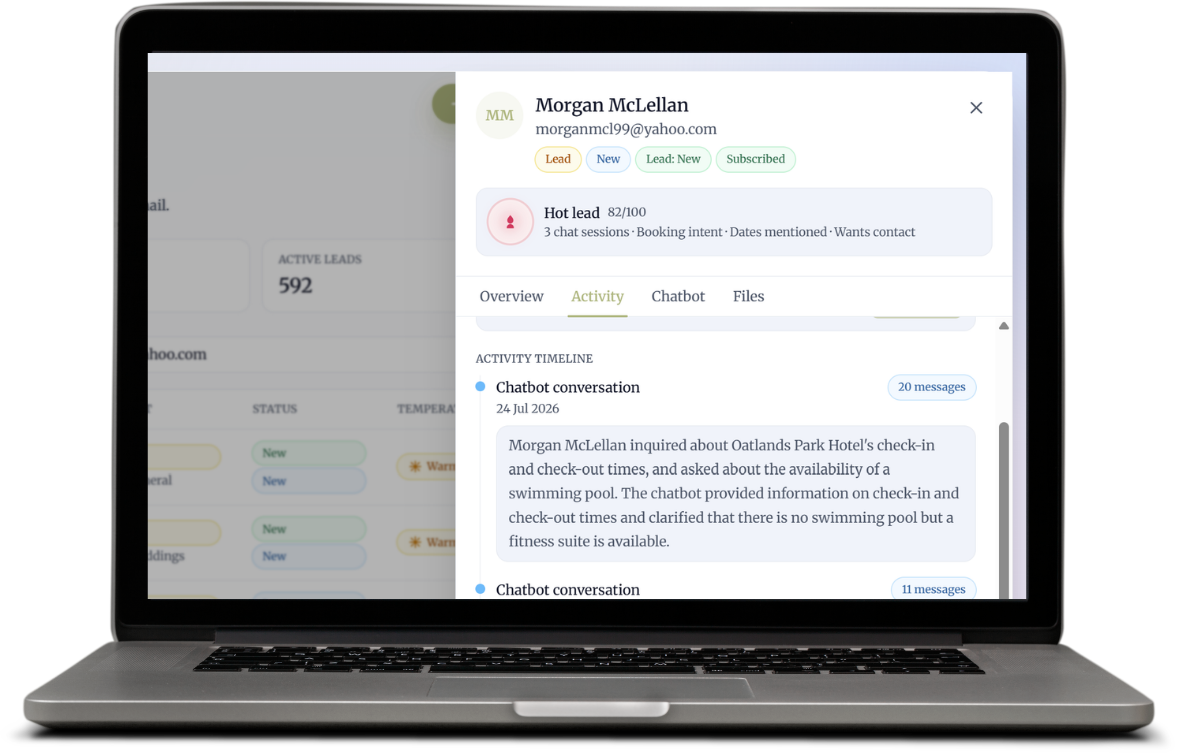
So we did the opposite. Every enquiry — website form, chatbot transcript or email reply — lands in a structured CRM record. Nothing is a lost email, and nothing depends on someone remembering to check an inbox.
Two systems, one platform
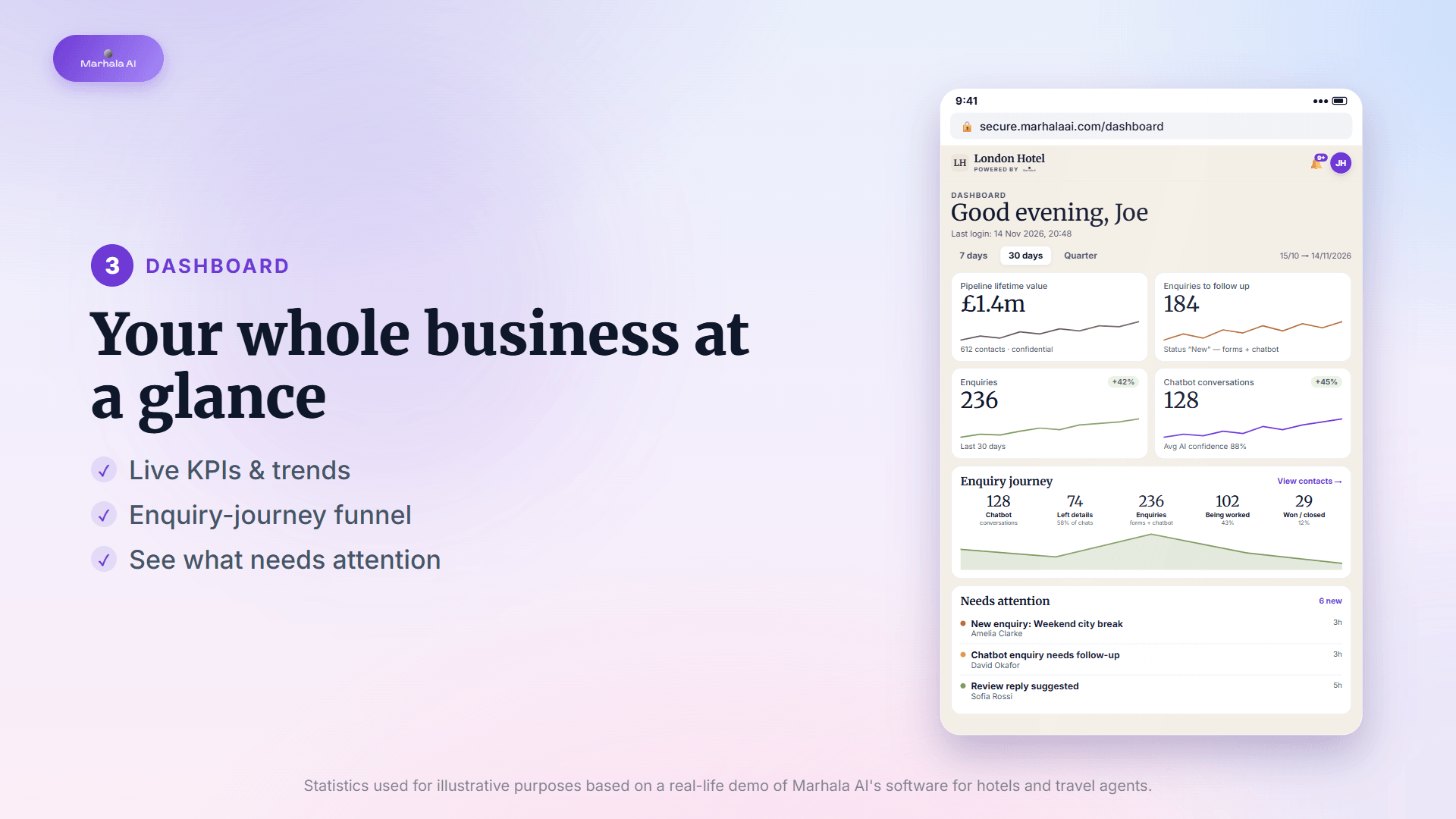
Marhala is built as two deliberately separate systems: a Node.js API service covering more than 30 feature domains — CRM, leads, chatbot, marketing, bookings, loyalty, documents, analytics and integrations — and a Next.js admin dashboard where hotel teams actually do their work.
They share nothing by accident. Every request is tenant-aware, with strict tenant isolation, so one property's data can never surface in another's. Role-based access control keeps it that way at the human level too: a Weddings Manager sees wedding enquiries, a Reservations Manager sees reservations, and neither sees the other's pipeline.
Security done properly, not just talked about
This is the part most AI startups skip. We didn't.
That isn't a marketing line. It's the reason we can hand a platform to a hotel and sleep at night.
- Personal data encrypted at rest, with sensitive guest documents and identity details protected by encryption rather than sitting in plain text
- Cryptographically verified webhook signatures, so an attacker cannot forge a message that appears to come from Meta or WhatsApp
- Role-based access control scoped to least privilege across every staff account
- HSTS, a strict CORS allowlist, rate limiting on public endpoints, runtime schema validation and parameterised database access throughout
- Regular OWASP vulnerability scanning, server-side scanning and full security audits of our servers, minimising the attack surface
AI that is safe by design, not by hope
Here's where the field gets dangerous. It's easy to wire up a language model and let it talk to customers. It's difficult to make it safe enough to trust with your brand.
Our chatbot is deliberately hybrid. A local natural-language engine handles intent, entities and typos, while large language models handle the genuinely complex questions. The models run through AWS Bedrock, with a multi-model fallback chain so no single provider outage takes the front desk offline.
And we constrain the AI hard:
- AI drafting replies attaches a confidence score and flags sensitive cases — an unconfirmed price, a frustrated guest, a topic needing a human — for staff review before anything is sent
- AI-written newsletters never generate links or images. The model writes only the prose, and every link, image and offer is resolved from live, verified CMS data
- Nothing is auto-sent to a guest without review. Accuracy beats autonomy
AI and UK GDPR: the part that actually matters
A lot of AI products in hospitality quietly ship guest conversations to a consumer model provider. Ours doesn't work that way, and the distinction matters.
Inference runs on AWS Bedrock rather than a consumer endpoint. Prompts and responses are not used to train models and are not retained by the model providers, which is precisely why we chose it over the alternatives that were quickest to integrate.
Crucially, the conversation record itself isn't stored with the model provider. It lives in the client's own database, under their control and isolated from every other property.
Guest consent for AI processing is recorded explicitly per contact, separately from marketing consent, and the platform can export and erase everything the AI has touched. Since we work with guests' personal details, data protection can't be an afterthought bolted on at the end. It has to be in the architecture.
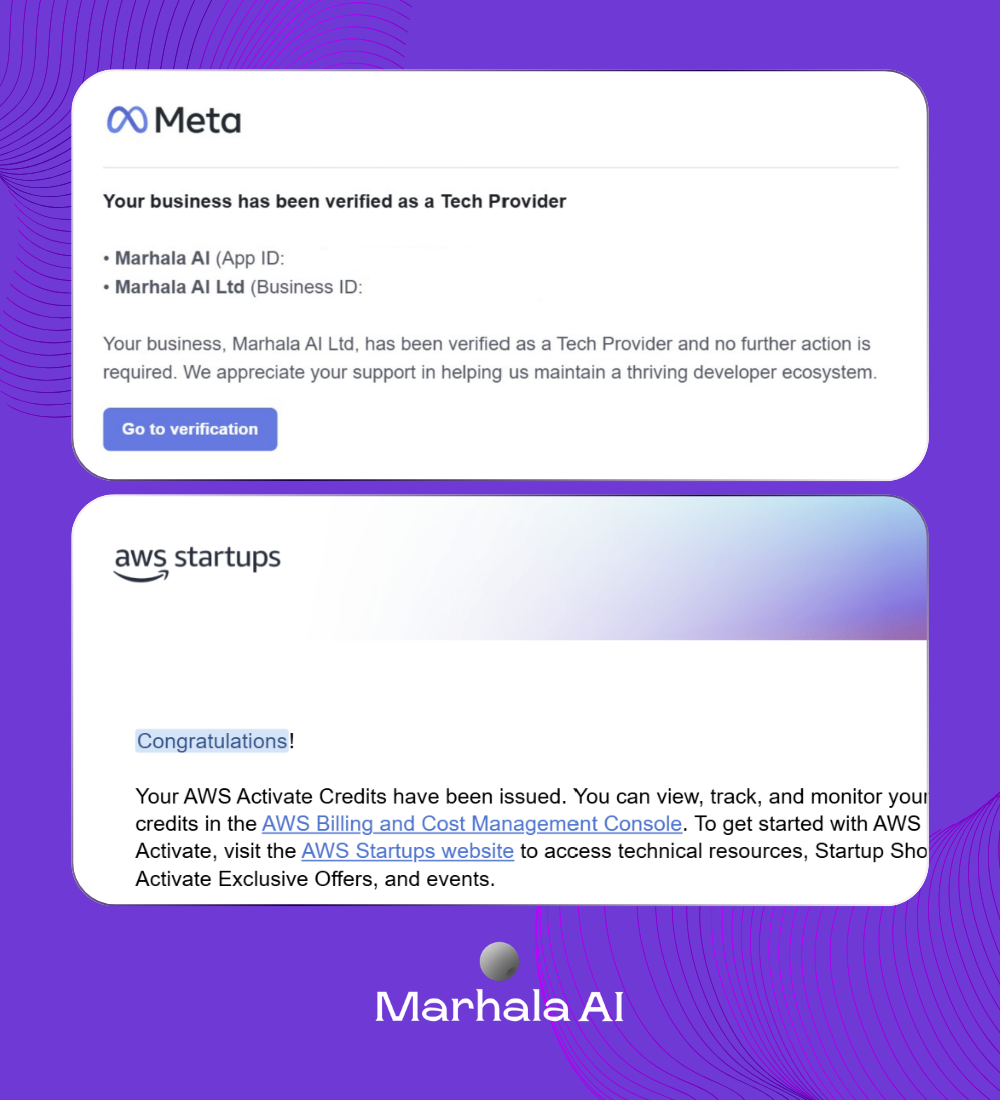
Our compliance work didn't happen by accident: we're registered with the ICO, approved as a Meta Tech Provider, and building on infrastructure where data residency and processor terms are contractual rather than assumed.
UK GDPR as an engineering discipline
Being compliant in the UK isn't a policy document you publish and forget. It's a set of features.
Ours include full data-subject tooling: a right-of-access export covering every dataset we hold, a cascading right-to-erasure that reaches across conversations, activity logs and uploaded documents, and an audit log recording every request, who made it and what happened.
We also built something most platforms don't have: a consent re-permission engine. It can write to a large newsletter audience, personalise each subject line by first name, and give every recipient a one-click unsubscribe using the RFC 8058 standard that mail clients understand natively.
It's rate-limited, isolated from the live platform and throttles itself to protect sender reputation. Sending at that volume doesn't fail because of code. It fails because of reputation, so we engineered for reputation.
The unglamorous work that makes it reliable
Reliability is invisible until it isn't.
Our background jobs — newsletter generation, consent campaigns and token refreshes — run as separate managed processes rather than bolted onto the API. They claim work using database leases, clean up stale claims and shut down gracefully mid-batch instead of dropping emails on the floor.
Database connections are actively kept alive and reconnected, because a silently dead connection is how enquiries go missing.
None of this shows up in a demo. All of it shows up at 3am on a Saturday.
Documents, parsed from real hotel systems
Not everything is an email. We integrate directly with leading property management systems, reading arrival reports that were never designed to be machine-read and turning them into personalised, print-ready welcome letters branded for each property.
What used to be a manual administrative job now takes seconds.
The 2026 achievements
Behind all of the above, this is what the year has actually looked like:
- Migrated a client from an ageing cloud provider to AWS, rebuilt and secured their website, and had them live and running in three weeks
- Approved for AWS Startups funding
- Joined the Stripe Climate Initiative
- Accepted into the Google Developers programme, shipping our Google Analytics integration
- Registered with the ICO earlier this year
- Approved as a Meta Tech Provider, supporting Facebook, Instagram, WhatsApp and Messenger through a unified flow
- Mentored a UK college student for over 100 hours across the summer, supporting his T-Level work placement through Marhala
The hard part is not the code
Building a UK AI startup in 2026 is harder than ever, and not for technical reasons.
Choosing a model that is genuinely UK GDPR-compliant, rather than one that quietly ships personal data offshore, is a real constraint. Add endless compliance checks, registrations, notarised legal documents and an hour in a phone queue to HMRC, and you start to understand why British talent flocks to tax-free havens in Dubai, Saudi Arabia and Singapore.
There is a peculiar irony in building sovereign AI capability in Britain while being ghosted by the very government bodies meant to support it. We just kept building anyway.
Where this goes next
Marhala is stronger than ever. The platform now spans CRM, chatbot, email marketing, social, bookings, loyalty, document generation, analytics and full GDPR tooling — all multi-tenant, all encrypted, all audited, and all built to survive contact with a real hotel on a busy Saturday.
I have a few calls coming up with some significant companies, and this is just the start.
If you run a hotel, a venue, or any business that lives or dies on responding to enquiries, the technology is ready. The question is whether your current setup can say the same.
Your front desk never sleeps. Now the software doesn't either.